All the content in the blog is available free of charge and can be found in the menu to the left.
Please feel free to scroll down in order to become acquainted with all the content which might possibly be of interest or of service to you

04/03/2014

Crowdfunding

On April 9th-10th 2014, the First International Death Online Research Symposium will take place at the University of Durham, UK, hosted by the Center for Death and Life Studies at the university.

Lately I've been invited to join the Death Online Research Network of international researchers and I hope to be able to attend the symposium in person. 

As I'm an independent blogger and researcher, I can't afford to pay for my flight and entrance tickets by myself, which is why I'm asking for your help. 

March 30th update:
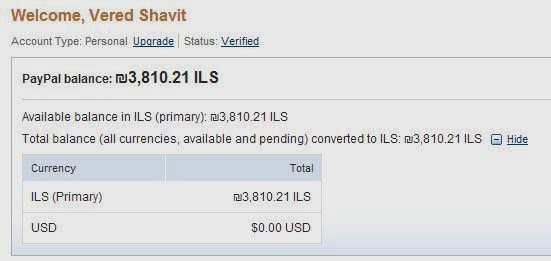
Amazing news: Thank you so much! the entire sum has been transferred: 3,800 NIS, after PayPal's commission: 


If 37 2 people will each transfer 50 NIS (15 USD / 10 Euro), and 74 4 people will each transfer 25 NIS (7 USD / 5 Euro), it will reach the sum necessary for covering the minimal expenses: 3,700 3,800 NIS, including covering the fees charged by PayPal for these transactions. Thank you! I have removed the PayPal button. 

If you can afford to take part and support this blog and this trip, I'll be very grateful. People were generous enough to support my previous attending in an international un-conference, almost a year and a half ago. The PayPal button is here on the left. When you type the sum it should be 25.00 or 50.00 (and not 25 or 50). You do not need a PayPal account to make this transaction: only a credit card. 

I will use the money collected by this crowdfunding solely for the purposes of financing this trip and will stop the possibility of transferring further funds once the necessary sum for covering the travelling expenses will be raised.  

I wish to make it very clear that although the PayPal button says "Donate", this is not a donation in the sense that I am not formally a non-profit organization, and I can't supply any receipts, let alone any tax-deductible receipts. 


The detailed costs: 

  • 675 $ flights Tel Aviv > London > Tel Aviv                             (2,360 2,410 NIS)
  • £80 accommodation at Durham for two nights 
  • £70 85 trains London > Durham > London 
  • £30 symposium registration                                       } £225 240 (1,320 1,380 NIS) 
  • £30 local travel expenses 
  • £15 dinner on April 9th

March 9th update: The crowdfunding campaign now has it's own video, thanks to Nimrod Benzoor's pro-bono work with me on making it: 


18/02/2014

Two International Digital Death Groups I'm a Member Of

In addition to my being an active member in the International community of Digital Death Day since 2012, I was invited to join the Network of Death Online Research in 2014, and I thank Prof. Gotved for the invitation.  


17/02/2014

Death in Facebook, Facebook and Death - Part One

I was about to leave the house when Koby, a Facebook friend of both my brother Tal and mine, sent me a startled message:

Koby Shabaty: “Has someone hacked Tal’s Facebook profile?????”

Of course all other plans were forgotten and I hurried to Tal’s Timeline (his wall) on Facebook. I looked for any signs of vandalizing and found none, much to my relief. I asked Koby what it was that alarmed him.


Koby Shabaty: “I saw he Liked something… I was a bit shocked".

Oh. That.

Fortunately, READWRITE, a technology blog, had a post titled Why Are Dead People Liking Stuff On Facebook which I bumped into not a week earlier, otherwise I have no idea how I’d have reacted to Koby’s screenshot:


Screenshot of a page being liked by my brother

Koby Shabaty: “Totally surreal, sadly there is no date indication".

That does look like Tal Liked something after his death.

The Facebook spokesman has an explanation: Those are past Likes that Facebook recycles and posts again. Not unlike Readwrite in this post, I admit I find this explanation not entirely credible, or at least not the only explanation. This page, liked by Tal, was indeed created before Tal had died - had it been created after his death it would have been a solid proof - and I have no way of knowing for sure, but I suspect there’s a different reason.

Statistics claim that three Facebook users die every minute.


From a clip by 'Life Insurance Finder', an Australian company, produced 2012

Tzach Ben-Yehuda‏, a lawyer-sociologist whose thesis dealt with anonymity in the web, told me once: “You can’t sell ads to dead people’s profiles on Facebook”, but it’s probably possible to fake their Likes. I don’t know whether it’s a bug or a deliberate malicious act, but I suspect there’s something in Facebook drawing Likes out of profiles.

The next case shows it’s indeed a past Like that’s been brought back, and here’s the reaction of a woman who ran into it - a friend of the deceased:


And this might be the biggest problem with financed promotions of Facebook content. I was staring at this item, that nearly made me cry, for long minutes. She had died two months ago. She probably no longer Likes this page; but I suppose the problem is in her profile’s settings. Surely there is a way to let Facebook know the user no longer lives and prevent such mishaps, and still, it makes me sick".

The Facebook spokesman said that, had the profile been defined as a Memorial profile, this would not have happened; no past Like would be re-used.

Once a user died, there are three options:

  • A family member contacts Facebook and asks for the profile to be deleted (this is only allowed for family members); 
  • Someone (anyone) reports to Facebook that the user has passed away, which will result in the profile changing to a Memorial profile (as far as Facebook is concerned, no personal relation to the deceased is required, nor should the user’s family be contacted or consulted with); 
  • Nobody informs Facebook that the user no longer lives, and their profile goes on functioning as usual. 
When choosing the latter option, Facebook is unaware of the user no longer being alive, and so treats them as usual - including suggesting the user as a friend for other users, or as a potential guest for their events - as happened to me, when Facebook suggested I invite two of my relatives to an event - and my deceased brother.


This hurts, but for me - and this is a personal preference and there are no rights or wrongs in this matter - this is a price worth paying for the profile not turning into a Memorial profile.

On January 2013 Huffington Post published an article titled Death On Facebook Now Common As ‘Death Profiles’ Create Vast Virtual Cemetery, introducing a person who was displeased by a deceased distant friend’s profile remaining untouched:

"In August [2012], Rohan Aurora, a 24-year-old biomedical engineering student and technology blogger who attends the University of Southern California, was on Facebook, reading news about friends back home in New Delhi, India. ...One friend from high school, Lalit Mendhe, had a photo posted on his Facebook page of himself in a hospital bed. He didn't look so bad, Aurora thought. "It didn't seem like he was very uncomfortable". So he made a quip on his wall, hoping to cheer up a friend stuck in the hospital, whatever the cause may have been..... Not long after, he got a message in his inbox from another one of Mendhe's friends. Mendhe, 23, had been in a car crash. He died of cardiac arrest and liver failure in that hospital bed.Aurora immediately deleted his comment. They hadn’t been very close, but would meet whenever Aurora was back in India. Facebook had allowed their bond to survive. It's been four months, and while Aurora misses his friend, he doesn't want to think about his death all the time. He says Facebook is forcing him to.One of Facebook's most loved and loathed elements is the "people you may know" feature. Based upon your location, university or workplace and the people one has friended, Facebook employs a formula to suggest users befriend people they "may know," usually friends of friends. Above a link to "add friend," Facebook shows the name and thumbnail photo of the suggested friend."One of my good pictures with Lalit, it came up on Facebook and it asked me to tag and identify this person. It's not good. You are tagging him at the wrong time. When I go through my pictures, I see his comment. I am forced to click on his name and look back," says Aurora. "A Facebook profile is an indication that someone is alive. We need to respect one's privacy".
The comments to those photos contain correspondence between Rohan and Lalit, when the latter was still alive.  


Aurora finds Facebook’s constant reminding him of his dead friend disturbing. This might have to do with him being young, or with the fact him and the deceased were not very close - but at any case, he feels uncomfortable with said distant friend’s profile not having become a Memorial profile. For others however, this Facebook presence of the deceased is far from disturbing; it is very welcome.

On April 27th, 2013, I was interviewed for a TV program in Channel 10. Healla Green, Alan Green’s wife, was interviewed to it as well. Her Facebook profile is named A.W - Alan’s Wife - and only after that does her own name appear, Healla Green. In the TV broadcast she tells how connected she felt to her husband’s profile after he had died, and how hard it was for her when Facebook changed it to a Memorial profile (it seems that for her the profile had simply vanished, but from her description I can guess that’s what happened to it). Facebook profiles aren’t deleted unless a family member requests them to be so, and even then it’s never immediate, as shown later in this post. However, since anyone can report anyone as dead - BuzzFeed have already proved this is hardly a challenge in this article, How Almost Anyone Can Take You Off Facebook (And Lock You Out) - I suspect this is what happened; someone was uncomfortable with Alan’s profile still giving the impression that Alan was alive, reported to Facebook of Alan’s death without discussing it with Alan’s wife first - and Healla, the wife, found herself locked out of her husband’s account, seeing as Facebook doesn’t require a family member’s permission to change a profile to Memorial. As Healla put it:

“I feel he was lost to me for the second time".


When a profile changes to a Memorial profile it can no longer be found through search engines, friends of friends can no longer view it - only those who are friends already - some of the content is deleted (the choice of what is removed and what remains is Facebook’s) and the account is no longer accessible, even if you have the password.

As explained and recommended in my technical guide, if you have access to the deceased’s Facebook account you should first backup its entire content, seeing as it can become a Memorial profile at any moment and you will no longer be allowed access to it. Following Healla’s case I also recommend to friend-request the deceased with your own Facebook account (open one if you don’t have one already) and approve it from theirs as long as you have access to it - and this way, at least, you will be able to view it even if it’s changed to a Memorial profile. Had Healla read the technical guide at the time, she might have not had to deal with this aspect of the pain, at least.

On April 2013 a Brazil judge ordered Facebook to remove, immediately, the profile of 24 years old deceased Juliana Ribeiro Campos, following her mother’s request. The mother says:


"On Christmas Eve many of her 200 friends posted pictures they had taken with her and recalled their memories. She was very charismatic, very popular. I cried for days".
The mother had requested Facebook to remove the profile several times over a few months, and then took legal action.


As we can see, the deceased’s Facebook profile can be as much a source of great comfort as it can be distressing, and that the combination of Facebook and death has many varied aspects. I will review those in my next post in this series.


Many thanks to Koby for his attention and caring.

Thank you Aya Shacham-Doman for translating this post.
04/02/2014

My Thoughts Regarding Google's Inactive Account Manager Service

In April 2013 Google launched a new service: Inactive Account Manager. I wrote about it here


At the time I only reviewed the service as-is. Now, as I had time to reflect on it, here are my thoughts: 

  • After a person dies, is it possible to contact Google and find out if he or she were registered to this service, as notifications are not sent during setup? 
    • If she or he were registered, is it possible to "speed things up"? - If a person chose to have his/her gmail account passed on to their spouse after several months, can their spouse get their copy of the account even if the allocated time has not yet fully passed?
      Obviously only upon proof of relationship plus death certificate plus access to the email account the deceased has specified for the download plus access to the phone number for a trusted contact the deceased provided, for example. But still - will Google allow it? Or must the spouse wait for the entire timeout period to pass?  
    • If Google do offer this check up, what should the family member do? Send a death certificate along with a query whether the deceased was registered? Is Google allowed to reveal this information? If so, to whom? And under what circumstances? 
    • If Google doesn't offer this check up option, or if the family is unaware of this service so they don't know they ought to look it up, does the family contact Google through "the usual channels" (detailed in the technical guide), only to find out after 3, 6, 9 or 12 months that the deceased had his/her own requests in this matter? Will Google alert them to the deceased’s registration for this service of their own volition?
  • Once you receive the email when the inactive account manager goes into action, is there a way to find out if there are other trusted contacts and/or who they are, and if so, how? (Google allows you to name up to ten trusted contacts when you set this up). 
  • Will Google prompt their users to use this service, like they prompt users from time to time to provide additional phone numbers / email addresses?
    Will they take it to the next level and insist their users use it? Like they insist users click on the "I read and agree to terms of use"? 

As some of you already know, as I express my opinion in this regard whenever I can, this is what I think Google should do: force their users to ponder their digital death and make a decision regarding their digital legacy, as most of them will not deal with it of their own volition, which is a pity. Once a person manages his or digital assets,: 1. His or her wishes will be carried out and 2. His or her loved ones will not have to go through the aches of wondering if they should or shouldn't access the deceased's digital realm, and if so, how. 

As far as I'm concerned, this solution isn't good enough because it doesn't let me choose whether I wish to bequeath my password or not: it decides for me that I can't. 

03/02/2014

My lecture: "Memory, Commemoration and Self Commemoration in the Digital Era" is now Available Online

When 'Digital Dust' turned one year old in July 2013, I gave a lecture in Google Campus TLV to mark the occasion. 

First I did a short review of the first year - cause that's what you do on birthdays, you look back and you say thank you


Then I presented the main lecture: "Memory, Commemoration and Self Commemoration in the Digital Era


And then I answered some questions


You can view the entire list of my lectures in English here, and in Hebrew here

Please feel free to schedule a lecture, in either Hebrew or English, by contacting me at: death.in.digital.era@gmail.com

13/01/2014

The Financial Aspect

Digital Death has financial aspects to it. 

A survey held by McAfee in 2011 shows that an
"Average Internet user has more than $37,000 in underprotected ‘Digital Assets’" 

They wrote about this in their blog, too. 

Another survey held by McAfee in 2013, shows that Singaporians have digital assets worth over 57,500 $:  


While Canadians own digital assets worth more than 32,000 $: 


That's a very good question: What's a password worth to you? But here is an even better question: How much will your passwords be worth to your loved ones, after you die, if they shall find themselves locked outside all of this? 


Iin December 2013, pwc (PricewaterhouseCoopers) published the results of a survey they held in England and Channel Islands, in which the citizens were requested to evaluate their digital lives. 


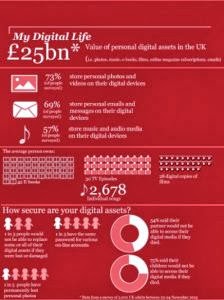
"UK consumers value their digital assets at £25 billion. This is the sum total of our personal digital assets – ranging from photos of loved ones to episodes of our favourite TV programmes. But the survey also reveals that in spite of spending over £50 billion a year buying goods and services online, many of us are not doing enough to protect the digital assets we value and spend so much of our incomes on. In fact, a third of us (31%) would not be able to replace some or any of the assets we have stored digitally if we lost them or they were compromised in some way".
The results of the survey can be downloaded as a pdf here

I'll let you in on a little secret: after their death, their loved ones will not be able to replace some or any of the assets they have stored digitally - unless action was taken in advance. 

Channel Islands’ consumers value their digital lives at £68 million. 


In Scotland, the same survey revealed that:

"SCOTS have a huge collection of items stored digitally, with experts valuing it at more than £2 billion".

Through an article published in The Guardian back in 2009, we learn that: 
"Tom Stuart was an active eBay member until he passed away in November 2007. His son, Darren, believes there could be up to £1,000 in his father's PayPal account. But he has been unable to gain access: his father left no will and no indication of what the password might be". 
In the third page of an article published even earlier, in 2007, in PC Pro, concerns were raised over potential loss of financial value, in ebay and etsy, for example, following a death. 

July 2014 update
In July 2014 McAfee published the results of their latest Digital Assets survey, held in India: 


You can read about the results in length in this PCQuest article. The results portray that: 
  • India has the second highest perceived value of their total digital assets, with an average cited value of US$ 41,589, preceded by North American (U.S. and Canada) having an average cited value of US$ 52,154.
  • 60% store digital assets on devices that would be impossible to re-create, re-download or re-purchase. 
  • 62% of respondents claimed that they do not protect smartphones with comprehensive security.
  • 85% of respondents claimed that they do not protect tablets with comprehensive security.


As food for thought, here is a list detailing (some of) the digital assets of financial value, and I thank Jonny Silver from the blog "Room 404" for his assistance in compiling it:  

  • A local / international bank account in an online banking service, or access to an online interface of a local / international bank account. 
  • An account in online stores (ebay, etsy, etc). 
  • An account in Crowd Funding websites. 
  • An account in an online investment service (stock exchange, foreign currency, etc). 
  • An account in an online gambling service. 
  • An account in an online payment service (such as PayPal). 
  • Subscription that fees were already paid for, such as online gaming services: xbox live, entertainment services such as Netflix, Hulu, Amazon Prime or itunes, backup services such as Dropbox or Google, newspapers subscriptions such as for The New York Times. 
  • Virtual assets that exist inside online services: for instance, in many games you can accumulate assets which have a financial value, or virtual assets you can buy / sell – sometimes worth tens of thousands of dollars. 
  • Applications, music, books and movies which were purchased to be used either through a device such as iphone, ipad, kindle etc., or via a digital service, such as Amazon Prime. 
  • Web related online assets, such as domains, hosting accounts and the data in it - all the contents and ingredients of a web site. 
  • Bitcoin and Bitcoin wallets.  


I hope this list will help motivate you into action: people who do not think their digital legacy is worth managing for sentimental reasons, might find it worth managing for financial reasons. 

A list of sites and companies offering simple, easy to use, free solutions for digital legacy management can be found here

21/12/2013

The Ugly Side of Digital Death

The first, and lighter, angle of the ugly side of digital death is "Ghosting". An article was published about it in 2012 (Thanks Kaliya Hamlin for sending me the link). 

Information published in obituaries is useful not only for friends and relatives of the deceased, but also for strangers intending to steal the deceased's identity. Obituaries generously provide potential thieves with another aspect of useful information: when will the relevant people be away from their homes, for attending a funeral, a wake or a viewing. The thieves take advantage and use this opportunity to steal physical objects which will both provide them with additional information, and help them tie themselves to the identity of the deceased at a later stage. In some cases, upon breaking into a home, items of financial value will not be stolen - only items related to the identity being stolen: a birth certificate, an ID card, a social security card and a driver's licence. 

One such case of a posthumous stolen identity which made headlines in 2012, is of an illegal immigrant who worked for 20 years as an international airport security supervisor in New Jersey - under the identity of a person murdered in 1992. He passed background checks as he had all the documents required, including a birth certificate and a social security card. 

Another case, which made headlines in 2011, is of a Bulgarian man, who for 15 years used the stolen name and birth date of an American toddler who was kidnapped and murdered when he was three years old, in 1982. This was revealed thanks to a routine check up performed by the U.S. State Department's Diplomatic Security Service, called "Operation Death Match": comparing passport applications to state death certificates. Thanks to this program, more than 150 stolen identities of the deceased were revealed, including that of a 41 years old Englishman who went under the identity of an American who passed away in 1994. 

In order to avoid "human ghosts" using the persona of someone dear to you who passed away, these article, video and post recommend that you minimize the data about the deceased you publish online, and notify all relevant parties, including credit card companies, banks and local and governmental authorities, of his or her passing. 


The second, and darker, angle of the ugly side of Digital Death is Death Trolling - a phenomenon which ranked seven in the list of the ten most disturbing online communities you might come across, published in August 2012 in the American website "The Next Web" (Thank you Ayeley Yagil for sending me this link). 

Luckily, I haven't come across this sickening, revolting phenomenon in person, of memorial pages and commemoration sites, targeted for destruction and bullying which add sorrow upon sorrow and pain upon pain - as in this case, when a memorial website for a 17 years old who killed herself in the US was mutilated

Sean Duffy displayed even greater cruelty and evilness: an English "Death Troll" who looked up children's memorial websites in order to mutilate them. He created horrible things such as a Youtube video in which the face of a 15 years old girl, who committed suicide on railway tracks, were placed on a moving train, with the soundtrack of "Thomas the Tank Engine" in the background.

In another appalling case, he wrote to the mother of a 14 years old girl who died of an epileptic seizure: "Help me Mummy, it’s hot in Hell".  

I admit it's not easy for me to put these atrocities in writing. 

Sean was arrested and jailed for 18 weeks - too short of a sentence, if you ask me. He was also banned from using social networking sites for five years - I wonder how this prohibition can be enforced. 

An earlier mention of this terrible phenomenon appears in NBC's news broadcast from March 2010 (Thank you Dr. Carmel Vaisman for sending me this link). They are addressing the same case of the 17 years old girl from the US, including quotes which are difficult to view: she committed suicide by hanging, and horrible cruelty was directed at her family as they were harassed by death trolls, bombarding them with multiple images of ropes and written remarks which included the word "hanging". The death trolls behaved in an even more appalling manner - which got omitted from this news coverage, in order to spare the viewers feelings , as can be seen (I mean, not seen) in this piece


NBC mention another - and earlier - horrifying case, from 2006, which received more media coverage - "earning" an 18 years old girl, killed in the US in a car crash when she lost control over the vehicle she was driving, her own Wikpedia entry
Photographs taken by Highway Patrol officers at the site of the crash later leaked to the Internet. They were not only posted and reposted online, but in an act of extraordinary cruelty, were sent to her family as attachments to email messages, under false, innocent headlines. They were cyber bullied so forcefully the family stopped using the internet all together for a while, took their other daughter out of school and put her into home-schooling. In this case too, the pictures fall under the category of images unfit for showing on TV - but, as it turns out, sadly for us all, can be shown online.