All the content in the blog is available free of charge and can be found in the menu to the left.
Please feel free to scroll down in order to become acquainted with all the content which might possibly be of interest or of service to you
Showing posts with label digital legacy. Show all posts

02/03/2015

Available For Free Download: A Guide For Dealing With The Digital Aspects Following A Death

I wrote a guide about Death In The Digital Era: Initial information about how to deal with the digital, virtual and online aspects of current deaths. It's a booklet you can read, download, save and print at any time and at no cost. 

The guide is aimed both at the grieving family members themselves and at the professionals who support bereaved people: psychologists, social workers, military professionals, volunteers in non-profit associations etc..  

I would appreciate getting your feedback about it: both if it was of assistance to you and if you have encountered - as part of your personal dealings or someone else's - additional topics which this booklet has not yet addressed. I'll be happy to broaden it and make sure it gives a precise and complete a guide as possible following such feedbacks. Please feel free to write to me either via email: death.in.digital.era@gmail.com or via the Facebook page of the blog. 


The guide can be found here. 
You can scroll in it using the keyboard arrows or the bar on the side.

The guide was first published in Hebrew on my brother's birthday: August 17th. Today, March 2nd, the date in which he was killed, it is published in English. 

I wish to thank the following people, without whom the English version might not have come into being: 

  • Amir Shemesh, who simply, one day, out of the blue, sent me an email saying: "Hi, I know you wish for your guide to be translated to English, enclosed please find the first draft" (we've never even met). 
  • Mórna O Connor,  a colleague and a friend, who, upon hearing that I was disappointed by someone who took the language check and proof reading upon herself and then disappeared, immediately suggested that she'll take this task upon herself in her stead. 
  • Shiri Yeshua, a graphic designer and a friend, who does all the graphic design for Digital Dust pro-bono since it first went online in 2012, and after designing the Hebrew version of the booklet, volunteered to also design the English version. 
I hope you know how much I appreciate your assistance and how awed and humbled I am by it. I simply could not have done it without you. Thank you for all the time, effort and good will you have put into this. 


I have deliberately focused in this guide on posthumous dealings. Managing our Digital Death issues while we are still alive is a different matter, which I hope to address in another booklet, but for now, this booklet intentionally deals only with after death digital issues. If you wish to know more about how to manage your digital legacy while you're still alive, please visit the following posts in this blog: 


In April 2014 AVG published their own free eBook for Dealing with Digital Death. It's written in an angle which is a bit different from mine, so you might find it of interest to you as well.

12/02/2015

Facebook Changes Their Posthumous Policy: You Can Now Choose Your Own Legacy Contact

Today, Feb. 12th, Facebook announced a new service: the possibility of Adding a Legacy Contact. 

April 30th 2015 update: This is now active in Canada as well as in the USA. May 12th 2015 update: featured in Australia, New-Zealand and Japan. July 27th update: available now in the UK too, and thanks Michael Diamond. August update: available now also in Finland and Denmark. Thanks Stine Gotved and Anna Haverinen for letting me know. September update: Now available in Israel too. 

Here are some quotes and images form their official press release: 


"Today we're introducing a new feature that lets people choose a legacy contact—a family member or friend who can manage their account when they pass away. Once someone lets us know that a person has passed away, we will memorialize the account and the legacy contact will be able to:
  • Write a post to display at the top of the memorialized Timeline (for example, to announce a memorial service or share a special message)
  • Respond to new friend requests from family members and friends who were not yet connected on Facebook
  • Update the profile picture and cover photo
If someone chooses, they may give their legacy contact permission to download an archive of the photos, posts and profile information they shared on Facebook. Other settings will remain the same as before the account was memorialized. The legacy contact will not be able to log in as the person who passed away or see that person’s private messages.
Alternatively, people can let us know if they'd prefer to have their Facebook account permanently deleted after death.
Until now, when someone passed away, we offered a basic memorialized account which was viewable, but could not be managed by anyone. By talking to people who have experienced loss, we realized there is more we can do to support those who are grieving and those who want a say in what happens to their account after death. 
Here's how to choose a legacy contact:
Open your settings. Choose Security and then Legacy Contact at the bottom of the page. 
After choosing your legacy contact, you’ll have the option to send a message to that person.
You may give your legacy contact permission to download an archive of the posts, photos and profile info you've shared on Facebook.
We’ve also redesigned memorialized profiles to pay tribute to the deceased by adding “Remembering” above their name and making it possible for their legacy contact to pin a post to the top of their Timeline. 
We're introducing legacy contact in the US first and look forward to expanding to more countries. Setting up a legacy contact is completely optional.  
Our team at Facebook is grateful and humbled to be working on these improvements. We hope this work will help people experience loss with a greater sense of possibility, comfort and support". 


A memoralized profile with
the word "Remembering" added to the name and 
a post created and pinned by the Legacy Contact. 

My first reaction is - Yay! Wow. A definite improvement to the existing (non-existing) Facebook policy in this regard. 

Facebook is the second company to offer an in-house solution: Google was the first, in April 2013, with her 'Inactive Account Manager'. You can read more about it in my posts here and here. 
Many websites offer options to manage your digital legacy - a list can be found in this post of mine here.
(Actually it's the second-and-a-half company if we were to count Yahoo! Japan's service as well). 


I still had a few questions after reading this press release, which I directed at Jodi Seth, a Facebook Spokesperson (Manager of Policy Communications, to be precise): 
    1. Q: What about pages the deceased was an Admin to? Will the Legacy Contact have access to those as well, even just to appoint another Admin?
      I hate seeing valuable content - of both sentimental and financial value - lost over an account being memorialized, when another Admin hasn't been appointed before or after the death of the sole admin of a page.
      A: No, the legacy contact only applies to personal profiles at this time, but it is something we will certainly think about as this evolves.
    2. Q: Has anything changed regarding what happens to an account of a person who dies without nominating a Legacy Contact? 
      A: Our current memorialization policies applies: someone can request the page be memorialized (viewable, but not managed by anyone), and the family may still request the account be deleted.
    3. Q: Will users be prompted to sign up for this service? 
      A: They will not. We have posted information in our newsroom and hope that and the media coverage will encourage people to sign up as they see fit.
    4. Q: I'm uncertain about tagging: can someone be tagged in a picture or a post once their account has been memorialized? If so, then: can the Legacy Contact control those tags? For instance, if a deceased person was tagged in an ad or something else which is unsuitable or inappropriate, can the Legacy Contact untag the deceased? (I didn't see any tagging reference here). 
      A: Memorialized accounts can be tagged, and whether or not the tag shows up to friends depends on the settings they had during their life. Legacy contacts cannot currently untag, but they can reach out to the person who tagged the deceased person and ask that they remove the tag. And anything that goes against our Community Standards can be reported and we would review and delete as appropriate. 
    5. Q: Will the Legacy Contact have permission to delete posts from the timeline after the account has been memorialized? For instance, if hurtful, un-kind posts were posted, could the Legacy Contact remove it?  
      A: No, we have a reporting process, which would allow people to report anything they feel violates our terms of service and Facebook would review and delete those things.
    6. Q: It states that the Legacy Contact can "Respond to new friend requests from family members and friends who were not yet connected on Facebook": how about a "Follow" button, if the deceased hadn't set one himself/herself while he/she were still alive? Could the Legacy Contact add a "Follow" button, for people who would not wish the befriend the deceased but would like to follow, for example?
      A: 
      No, a legacy contact could not add a follow button. 
    7. Q: Will the Legacy Contact be able to write a post on the timeline of the deceased and pin it there even if the "Who can post on your timeline?" settings was set to "only me" at the time of the death? If the timeline was set to "only me", will the Legacy Contact be able to change that to "friends", in order to allow the friends and family members of the deceased to express their grief there?
      A: 
      A legacy contact could not change the settings  that the account holder had in life - so if the person did not allow anyone to post on his or her timeline in life then the Legacy Contact could not change that after death.
    8. Q: Could the Legacy Contact position be revoked or transferred? For instance, if a couple breaks up, could they revoke the position they have previously appointed to their former spouse, and/or transfer the position to their new spouse?
      A: Yes, a person may change their legacy contact as often as they like before death.
    9. Q: Has the policy changed regarding who can notify Facebook about a death of a user and/or how that notification is made? 
      I find the current policy, of anyone being able to report anyone, and that all that is required is a link to an obituary, troubling. 
      This is what a form to 'Report A Deceased User' used to look like and this is what a 'Memorialization Request' looks like now. Does it only LOOK different, or is there a change of policy too behind the change in appearances?
      A: Anyone can request memorialization, but it is verified by our community operations team who thoroughly reviews each request – we ask for an obituary or news article, but we also use other social cues to verify that the request is legitimate. We have very low rates of false memorializations. Deleting an entire account after memorialization can only be requested by immediate family and that requires a death certificate. Memorialization requests are handled the same way.


                    October 2015 update: I wrote a separate post, explaining why I don't think this is a good and comprehensive enough solution, although it is an important step in the right direction. 

                    Jed Brubaker is a PhD candidate in the department of Informatics at UC Irvine. Facebook involved him in this project as an academic collaborator, to share findings from his six years of researching death and grief on social media, and to provide feedback and guidance during the design and development of Legacy Contacts. 

                    If you want to take this opportunity and become more acquainted with Jed's work, here are a few useful links: 

                    • Projects:
                    • Publications: 
                      • “We will never forget you [online]” : An empirical investigation of post-mortem MySpace comments. Proc. CSCW 2011. Hangzhou, China. March 19–23, 2011. [pdf]
                      • Grief-Stricken in a Crowd: The language of bereavement and distress in social media. Proc. ICWSM-12. Dublin, Ireland. June 4-8, 2012. [pdf] 
                      • Beyond the Grave: Facebook as a site for the expansion of death and mourning. The Information Society, 29, 3. [pdf]
                      • Death, Memorialization, and Social Media: A Platform Perspective for Personal Archives. Archivaria, 77, 1-23. [link]
                      • Stewarding a Legacy: Responsibilities and Relationships in the Management of Post-mortem Data. Proc. CHI 2014. Toronto, Canada. April 26 – May 1, 2014. [pdf]

                    04/02/2014

                    My Thoughts Regarding Google's Inactive Account Manager Service

                    In April 2013 Google launched a new service: Inactive Account Manager. I wrote about it here. 


                    At the time I only reviewed the service as-is. Now, as I had time to reflect on it, here are my thoughts: 

                    • After a person dies, is it possible to contact Google and find out if he or she were registered to this service, as notifications are not sent during setup? 
                      • If she or he were registered, is it possible to "speed things up"? - If a person chose to have his/her gmail account passed on to their spouse after several months, can their spouse get their copy of the account even if the allocated time has not yet fully passed?
                        Obviously only upon proof of relationship plus death certificate plus access to the email account the deceased has specified for the download plus access to the phone number for a trusted contact the deceased provided, for example. But still - will Google allow it? Or must the spouse wait for the entire timeout period to pass?  
                      • If Google do offer this check up, what should the family member do? Send a death certificate along with a query whether the deceased was registered? Is Google allowed to reveal this information? If so, to whom? And under what circumstances? 
                      • If Google doesn't offer this check up option, or if the family is unaware of this service so they don't know they ought to look it up, does the family contact Google through "the usual channels" (detailed in the technical guide), only to find out after 3, 6, 9 or 12 months that the deceased had his/her own requests in this matter? Will Google alert them to the deceased’s registration for this service of their own volition?
                    • Once you receive the email when the inactive account manager goes into action, is there a way to find out if there are other trusted contacts and/or who they are, and if so, how? (Google allows you to name up to ten trusted contacts when you set this up). 
                    • Will Google prompt their users to use this service, like they prompt users from time to time to provide additional phone numbers / email addresses?
                      Will they take it to the next level and insist their users use it? Like they insist users click on the "I read and agree to terms of use"? 

                    As some of you already know, as I express my opinion in this regard whenever I can, this is what I think Google should do: force their users to ponder their digital death and make a decision regarding their digital legacy, as most of them will not deal with it of their own volition, which is a pity. Once a person manages his or digital assets,: 1. His or her wishes will be carried out and 2. His or her loved ones will not have to go through the aches of wondering if they should or shouldn't access the deceased's digital realm, and if so, how. 

                    As far as I'm concerned, this solution isn't good enough because it doesn't let me choose whether I wish to bequeath my password or not: it decides for me that I can't. 

                    13/01/2014

                    The Financial Aspect

                    Digital Death has financial aspects to it. 

                    A survey held by McAfee in 2011 shows that an
                    "Average Internet user has more than $37,000 in underprotected ‘Digital Assets’" 

                    They wrote about this in their blog, too. 

                    Another survey held by McAfee in 2013, shows that Singaporians have digital assets worth over 57,500 $:  


                    While Canadians own digital assets worth more than 32,000 $: 


                    That's a very good question: What's a password worth to you? But here is an even better question: How much will your passwords be worth to your loved ones, after you die, if they shall find themselves locked outside all of this? 


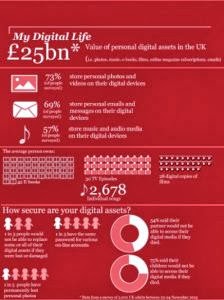
                    Iin December 2013, pwc (PricewaterhouseCoopers) published the results of a survey they held in England and Channel Islands, in which the citizens were requested to evaluate their digital lives. 


                    "UK consumers value their digital assets at £25 billion. This is the sum total of our personal digital assets – ranging from photos of loved ones to episodes of our favourite TV programmes. But the survey also reveals that in spite of spending over £50 billion a year buying goods and services online, many of us are not doing enough to protect the digital assets we value and spend so much of our incomes on. In fact, a third of us (31%) would not be able to replace some or any of the assets we have stored digitally if we lost them or they were compromised in some way".
                    The results of the survey can be downloaded as a pdf here. 

                    I'll let you in on a little secret: after their death, their loved ones will not be able to replace some or any of the assets they have stored digitally - unless action was taken in advance. 

                    Channel Islands’ consumers value their digital lives at £68 million. 


                    In Scotland, the same survey revealed that:

                    "SCOTS have a huge collection of items stored digitally, with experts valuing it at more than £2 billion".

                    Through an article published in The Guardian back in 2009, we learn that: 
                    "Tom Stuart was an active eBay member until he passed away in November 2007. His son, Darren, believes there could be up to £1,000 in his father's PayPal account. But he has been unable to gain access: his father left no will and no indication of what the password might be". 
                    In the third page of an article published even earlier, in 2007, in PC Pro, concerns were raised over potential loss of financial value, in ebay and etsy, for example, following a death. 

                    July 2014 update
                    In July 2014 McAfee published the results of their latest Digital Assets survey, held in India: 


                    You can read about the results in length in this PCQuest article. The results portray that: 
                    • India has the second highest perceived value of their total digital assets, with an average cited value of US$ 41,589, preceded by North American (U.S. and Canada) having an average cited value of US$ 52,154.
                    • 60% store digital assets on devices that would be impossible to re-create, re-download or re-purchase. 
                    • 62% of respondents claimed that they do not protect smartphones with comprehensive security.
                    • 85% of respondents claimed that they do not protect tablets with comprehensive security.


                    As food for thought, here is a list detailing (some of) the digital assets of financial value, and I thank Jonny Silver from the blog "Room 404" for his assistance in compiling it:  

                    • A local / international bank account in an online banking service, or access to an online interface of a local / international bank account. 
                    • An account in online stores (ebay, etsy, etc). 
                    • An account in Crowd Funding websites. 
                    • An account in an online investment service (stock exchange, foreign currency, etc). 
                    • An account in an online gambling service. 
                    • An account in an online payment service (such as PayPal). 
                    • Subscription that fees were already paid for, such as online gaming services: xbox live, entertainment services such as Netflix, Hulu, Amazon Prime or itunes, backup services such as Dropbox or Google, newspapers subscriptions such as for The New York Times. 
                    • Virtual assets that exist inside online services: for instance, in many games you can accumulate assets which have a financial value, or virtual assets you can buy / sell – sometimes worth tens of thousands of dollars. 
                    • Applications, music, books and movies which were purchased to be used either through a device such as iphone, ipad, kindle etc., or via a digital service, such as Amazon Prime. 
                    • Web related online assets, such as domains, hosting accounts and the data in it - all the contents and ingredients of a web site. 
                    • Bitcoin and Bitcoin wallets.  


                    I hope this list will help motivate you into action: people who do not think their digital legacy is worth managing for sentimental reasons, might find it worth managing for financial reasons. 

                    A list of sites and companies offering simple, easy to use, free solutions for digital legacy management can be found here. 

                    18/07/2013

                    How to Handle a Computer Belonging to a Deceased Relative? - My Own Way of Coping

                    Coping with the digital legacy of the deceased is a delicate, difficult, intricate and extremely personal matter. When I took it upon myself to go through my brother's personal computer, who was killed when he was hit by a car at the beginning of 2011, I felt very lonely, as if I was the first person on earth to deal with this heavy load (this of course is not true, but that's how I felt at the time). If you are also in this grim predicament, I would like to share with you my way of dealing with my brother's legacy. There are, of course, many ways to do this, and no one way is better than the other. This one was simply my way.

                    My brother was killed when he was 55 and a half years old, divorced, with two children in their early 20s. A man who lived life to the fullest, with personal and professional relationships and an unusual knack to touch the lives of many.

                    It was clear to me that I should have to go over his personal computers before handing them over to his children, in order to neatly "fold" away his life in the most respectable manner. There were saved files with professional material that I wanted to forward to his colleagues, there were friends who requested me to remove personal correspondence from it and I also received requests from friends and acquaintances for pictures Tal took but didn't have the chance to send out.

                    The email accounts
                    I got into each of my brother's email accounts and proceeded to do exactly the same in each:
                    1. By using the search engine that all email service provider have, I searched for both the addresses and names of those who requested me to delete their correspondence with Tal. As soon as their name or address appeared, I deleted those mails from both the inbox and the sent mail box, without reading them (I mean, of course, permanent deletion, not just moving to the trash file).
                    2. I arranged the mail messages according to the name of the sender, and opened the first mail from every sender with a female-sounding name: If it was a professional correspondence, I didn't touch those mails and did not open other messages from the same sender.
                      If the correspondence was of a personal, private matter, I closed the message as soon as I recognized it, so I would not read anything beyond the bare minimum needed for identification, and deleted all mail received from this sender without reading them (so if you dated my brother and are now reading this post – you should know that no one other than you two read your correspondence). 
                      I continued in the same manner for every name in the inbox.
                    3. I did the same as in article 2, this time in the "Sent Items" box: I arranged all mail messages by name of recipient, opened the first message that was sent to a recipient with a female-sounding name, and repeated the process described in the previous article.

                    An image I found online, demonstrating the process – this is not a print screen of my 

                    brother's email account


                    The Computer
                    • I opened his Pictures folder (luckily, my brother was a highly organized person, which made the search easy) and used the operating system's search option to track down both the images I was requested to delete and those I was requested to send copies of. Sometimes the search required a few search words or values: the name of the person in the picture / the model of the motorbike in the photo /  the photo's date / the photo's location, etc., so I wished to get as many details and data, to locate the specific pictures. Luckily, I was able to track down all the pictures, although at times it took longer than expected.
                    • I tracked down images and files which I thought Tal's friends and colleagues may want to have – their pictures with Tal, pictures Tal took of them, etc., and made sure they got copies.
                    A Very Different Approach

                    I admit that it was hard for me to read of the choices made by Alison Atkins' family. The 16 year-old Canadian, who died from severe Colitis, seemingly wanted to keep certain things private even after she passed, but her family did not respect her wishes:

                     Alison's sister attempts to reset Alison's passwords made things worse. She couldn't reset Facebook without access to Alison's Yahoo mail account. But when she tried to log in to Yahoo, it asked her a series of "challenge" questions, put in place by Alison, which she kept getting wrong. She suspects her sister intentionally put in the wrong answers to the questions. "Very sneaky on Alison's part," she says. The same happened with Microsoft Hotmail. ...Alison's sister discovered some of Alison's most intimate thoughts and feelings... On her Tumblr account, Ms. Atkins found a password-protected second blog under the heading "you wouldn't want to know".

                    To me, this is a very clear "do not enter" sign. Alison's family did not think that way and did enter that blog, in which her sister found posts she described as "dark".

                    Alison Atkins


                    Alison was bedridden and aware that she was very ill. She did not die suddenly like my brother. From what I understand from the article, she did consider her digital legacy and chose not only to keep her passwords from her family, but also put obstacles if they tried entering her virtual space.


                    Again, I am not judging the Atkins family, in their immense pain, and it is possible that because of Alison's young age, her family members felt entitled to enter her digital life, online and virtual, after she died.


                    You Are Not Alone
                    I find it important that people who have lost their loved ones and have arrived at this post from browsing the web, may find it useful even if their choices are totally different than mine, finding solace in the fact that they are not alone in trying to cope. You are more than welcome to email me (even anonymously) with your own account of dealing with digital legacy, or even leave a comment here – perhaps reading this will be helpful for other people coping with a similar situation.


                    Dealing with digital legacy is hard and painful, partially – I believe – because there is yet to be any public acknowledgement of the subject: before dealing with the deceased's physical legacy and property (such as his home), it's common knowledge that the experience will be difficult, grim and painful. People prepare you for it, and you prepare yourself.

                    There is still no common knowledge about how difficult, grim and painful (as well as technically challenging at times) it is to enter someone's digital legacy. People around you are still unaware that they need to prepare and support you during the process, and you still do not know how to prepare for it. I hope that at least in this aspect I can be of assistance to others. I recommend reading my post "After death – caution and attention" before dealing with someone's digital legacy. Additional information you may find helpful can be found in the Technical Guide post.


                    Thank you Ayelet Yagil for translating this post. 

                    30/05/2013

                    Heading towards a change in Israeli legislation?

                    Following the meeting in ILITA (Israeli Law, Information and Technology Authority in the Ministry of Justice); I had a meeting at the Ministry of Justice in early April 2013 with the following representatives: the Head of litigation and advisory department, attorney Erez Kaminitz, Director of Intellectual Property Law; attorney Howard Poliner ; attorney Ariel Zvi and interns Yishai Pearlman and Moshe Frucht; and attorney Nir Gerson, who is Head of Technology at ILITA.

                    I introduced the following topics: digital legacy, digital estate planning, digital and virtual assets and property; and have briefly reviewed the situation in these fields, both generally and legally:


                    I presented the current situation in Israel: No network provider publishes its policy in case of death of the user; some have questionable policies; another company has yet to answer: 
                    We focused on Israeli inheritance laws, and deconstructed basic concepts: will the definitions used worldwide will also apply here? The word inheritance bears legal meanings when using the terminology of digital inheritance, and decisions about how to treat such meanings in Israel has yet to be taken. 

                    This was an initial meeting, to mark the beginning of a process, but I did left the meeting feeling that such process exists, as well as people to communicate with in his regard. I met people who, recognizing the importance of this subject, appeared genuinely interested in learning more; and I do hope that as a result, Israeli legislation will eventually be changed.

                    I will keep updating. 


                    Thank you Noa Ron for translating this post. 

                    22/07/2012

                    Before death: commemorating yourselves and leaving instructions behind

                    Several websites already offer ways to creating your own commemoration and / or leaving instructions behind, to be filled after your death: 
                    • "B Celebrated" - "Create your autobiographical legacy website. Share your story with your words, images and audio. Automatically email your community when you pass away.  Leave a permanent site where your friends and family will celebrate your life."
                    • "Parting Wishes" - "Document your funeral wishes and organ donation preferences. Specify your health care wishes in case you are ever unable to communicate. Create a web page about your life which only goes online after you pass away."
                    • "After Steps" - "Estate planning, financial planning, funeral planning and legacy planning": from organ donations (or not) to how to best take care of your pets.
                    • The iPhone application "Legacy Organiser" - "Major events, private moments, memoirs, photos or songs that have been of great significance throughout your life can now be conveniently stored in one place. Should you wish, you can also share information with friends and family through Facebook. Create your Life Album by choosing photographs that reflect your life. Compile the Soundtrack of your Life by selecting songs that have captured the fun, the laughter, and the tears. Reflect on your life and record details of life affirming occasions, experiences and memories that have meant so much to you in Events. Plan ahead and put together your own Bucket List so you have a complete list of the goals and dreams you have yet to achieve. Legacy Organiser enables you to record important information relating to your death including your final intentions and wishes for all aspects of your farewell, your funeral arrangements, and your digital estate. Create and take control of your own legacy, of who you are and how you want to be remembered."
                    • As written in "My Wonderful Life", "You only get one chance to make a last impression" - "Make funeral plans. Write your obituary. Design your own headstone. Take care of your pets".
                    • The project "Remembered Voices, which I personally found extremely moving, allows you to record your voice and enter it to their voice library. We can leave behind what we sounded like, how we laughed, how we phrased our sentences. We can leave behind a bedtime story or a lullaby for our children, or leave behind our life story told in our own voice.
                    • Recollect offers something a bit different: "We archive everything you do online". This websites offers to archive pictures, tweets, and check-ins from various accounts across the internet, back it up and allow you to download it anytime, and allows you to search among tweets, Foursquare check-ins, Instagrams and Flickr photos, at the same time. While this could be good for you, it could be invaluable to your heirs. 
                    • GEN-ARC (which acquired Scangaroo) "provides key features and functionality that are critical to permanently preserve the priceless content in your family archive (your “GEN-ARC™”) and ensuring it remains viewable by forward generations". 
                    • Final Fling allows you to "record Wishes, start a bucketlist, leave last requests, pick funeral music, make a Will, appoint a trusted Keyholder"..."A Treasure Trove for digital legacies: tell your story, leave messages, pass on pics or home movies"... "A Scrapbook to share tributes, ideas, inspiration for fitting ends".
                    Some of these sites were shut down: 
                    • "1000 memories" - "Organize, share and discover the old photos and memories of your family and friends. We help bring the albums, scrapbooks, and photo-filled shoeboxes of our lives out of the closet and into an online, shareable space where they can be remembered and celebrated, together in one place." October 2012 update: the website was acquired by Ancestry.com and was later shut down.  
                    • Memolane shut down at February 2013. 

                    I have found many of these links at The Digital Beyond and credit and thanks go to Evan Carroll and John Romano for compiling it. 

                    Before death: Managing your Digital Legacy / Assets / Estate

                    I'm a little (OK, a lot) behind on updates in several posts in the blog. This is one of them. Sorry about that, readers: I hope to catch up soon. 

                    ------------------------------------------------------------------------------------------------------------

                    Quire a few companies now offer Internet-based solutions, due to the rising awareness of the importance of managing digital and online assets. The services offered by Legacy Locker, Data Inherit and Entrustet were reviewed in my 3rd ynet article in July 2011. 
                    In April 2012 Entrustet was purchased by SecureSafe, formerly known as Data Inherit, becoming one of the leading - and bigger - companies. 
                    Update: PasswordBox acquired Legacy Locker in November 2013. They now offer a digital life management solution for both before and after death. Update: Intel acquired PasswordBox in December 2014.   

                    I highly recommend choosing the company and service which suit you best and start using their services. By doing so, you will ease what your loved ones will go through after your death. This is also your way of guaranteeing you will control who gets access to what - and what gets deleted before anyone gains access to it. You will also spare them the part of wondering if they should access your digital and online assets or not and if yes, how. 

                    A very good infographic by the Australian company Life Insurance Finder, detailing what actions are recommend to be taken and in which order, can be found here: step by step expert guide to protect yourself online before you die. 

                    May 2013 update: Google are the first company to offer an in-house solution - I wrote a separate post about it. 

                    Legacy Locker
                    "A safe, secure repository for your vital digital property that lets you grant access to online assets for friends and loved ones in the event of loss, death, or disability."

                    Entrustet
                    "Probably without considering it, you have acquired and created numerous, significant digital assets, and traditional wills and trusts don't sufficiently address, manage or protect them. Entrustet provides the tools and resources to create a free, secure list of your digital assets, nominate heirs, specify a Digital Executor and decide which assets to transfer or delete after you pass away".
                    Entrustet was purchased by SecureSafe in April 2012. 

                    Data Inherit 
                    "With DataInherit, you can easily assign beneficiaries to your digital assets in the event that something should happen to you. This will preserve your digital assets for you, your family or your partners". Data Inherit became SecureSafe. 

                    SecureSafe


                    Companies who offer similar services are: 
                    As this market keeps changing (as seen with the merges and acquisitions above), some websites have been shut down and are no longer available: 

                    I do not presume to keep a comprehensive list of all companies offering these services. The Digital Beyond do a great job of doing just that (among other things).