Is there a need for new social conventions about what is acceptable or polite in the digital era, and what isn't?
Social conventions have already changed somewhat: in the past, it was customary to call when you wanted to say "Happy Birthday" or "Happy New Year". Today, more people prefer to text, and many post on friends’ Facebook pages. It’s also acceptable to get birthday party invitations - or even news of engagement and marriage - online.
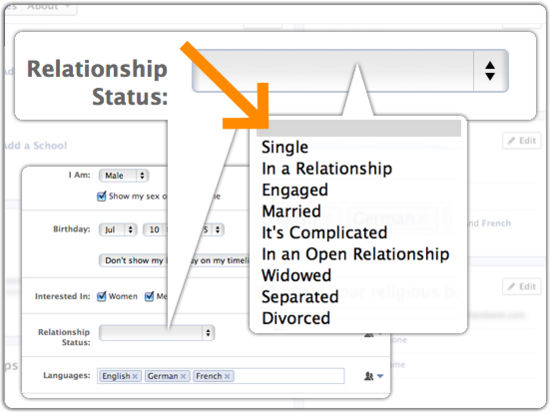
Updating the relationship status in Facebook
It's interesting to note that what is acceptable in Israel regarding birthdays and engagements isn’t (yet?) acceptable, as far as weddings are concerned: it is still customary here to send printed wedding invitations by mail, and often to deliver them by hand. Elsewhere, electronic wedding invitations are common, and RSVPing is done online. (Amit Bar-Tzion, CEO and Founder of easywed, confirms that it's not only my personal impression: "There are some online invitations in Israel, but only a few. Print rules the day").
Will the social conventions in Israel change, and in the future will we accept online wedding invitations as a matter of routine?
![]()

Wedding attendance - online RSVP
In Israel, we have grown to accept electronic invitations to a memorial service, to a "Shivah" (a Jewish tradition: marking the first seven days of mourning) or to a "Shloshim" (marking the first 30 days of mourning). What about electronic notices regarding death or a funeral? Are these in the same range of Israeli social conventions as weddings? What will make an online wedding invitation - or a funeral invitation - personal enough for us to feel comfortable sending and receiving them?
Are norms of "acceptable" or "polite" online affected by the social conventions in that geographical region? In Israel, religious Jewish funerals are held as soon as possible after death, sometimes as early as the same day. Elsewhere, a few days can pass from the moment of death to the funeral or service.
In Israel, compared to abroad, there is a need to let as many people know as possible, as fast as possible, so social networks, emails etc. should have been accepted here as a legitimate way, because they answer those needs. Is there more inclination - and more time - abroad, to prepare personalized, designed invitations to a funeral or a service, which isn't available here? Will this turn the Israelis into people who more readily accept notices of bad tidings through digital formats?
In Israel, compared to abroad, there is a need to let as many people know as possible, as fast as possible, so social networks, emails etc. should have been accepted here as a legitimate way, because they answer those needs. Is there more inclination - and more time - abroad, to prepare personalized, designed invitations to a funeral or a service, which isn't available here? Will this turn the Israelis into people who more readily accept notices of bad tidings through digital formats?
A cousin of a friend of mine passed away unexpectedly. Her mother wrote on her daughter’s Facebook timeline a message: "She is no longer with us", along with the date and time of her funeral. Another cousin of his saw it and wrote to my friend: "I saw something strange posted on our cousin's Facebook page. Is this a joke?". My friend had to tell him that, sadly enough, it wasn’t.
My friend C. recently found out twice through Facebook about deaths: the first time was when the husband of her dear friend S., who passed away after a long term of illness, wrote on S.'s profile - and through her user, not through his - that she passed away, along with the details regarding the funeral. The second time was when three mutual friends of C. and her friend A. wrote in Facebook that they couldn't believe A. was gone - and she didn't know neither that he passed away nor under which circumstances it happened.

Will writing on Facebook replace coming in person to a memorial service, as writing in Facebook replaces making a phone call on a birthday? Will social networks replace the way we mark sad occasions, in the same way they changed the way we mark happy ones? Or will funerals and memorial services, like weddings, remain in the area in which we feel more comfortable in the physical sphere, rather than in the virtual one?
Will the next stage be that funerals be broadcast live on the Internet? Will it make us feel closer, as those who can't attend in person will at least be able to watch? Or will it make us feel farther apart, because less people will attend the funeral in person, and prefer watching it from afar? Will a social norm - under which it is legitimate to tweet your condolences -create a society in which more people will pay their virtual respects, and less people will be there to comfort grievers in person? ![]()

Mourning on Twitter - from Life Insurance Finder's infographics.
Andriana Cassimatis' mother passed away in 2007. In an interview to Digital Dust, she wrote:
I had so many other things to organize before the funeral, that calling each and every guest to tell them all of the details such as time, place and directions seemed a daunting task. Of course I phoned close family and friends to notify them of the actual death, but then I followed that brief phone call up with an email that contained a link to a custom website I had made for her, which contained all of the practical details. It worked very well. I was free to focus on other things and all of the guests found their way to the event.
Andriana had four days between the time her mother passed away and the time the ceremony was held - time enough to create and upload this mini site. She also used this site as a way to communicate with the guests, asking them, for example, instead of bringing or sending flower arrangements, to make a donation to a specific breast cancer foundation. (this solution worked perfectly for her, but it doesn't mean someone else might not feel differently: that a website is too cold or too estranged of a solution, and would prefer to make these phone calls in person, or maintain direct interactions with the other grievers).
Andriana:
In the past three - four years, funeral homes have started to promote the practical details of funeral events on their websites. There are also a handful of memorial sites which are beginning to offer this information as well. The problem for me is that none of these sites seems sincere or personal in any way. The overall visuals and content have never been updated to reflect our design conscious generation or include different cultures.
Here is an example of an online invitation a funeral home posted when her aunt passed away:
As you can see, it's attached to the funeral home's main site and it has all the practical details - it's just void of any personality or representation of that person.
Andriana feels...
"There will never be a more appropriate event when using technology is of great benefit - usually due to tight time constraints concerning burial or cremation traditions. Technology allows us to notify a lot of people all at once. But by the very personal nature of death itself, people are still struggling with what is acceptable etiquette. That is why finding a good bridge between these two - technology and sincerity - is the key. Yes, people are much more likely to send online invitations to happy occasions such as weddings and birthdays and that is where we see the most creativity happening. Death in terms of creativity has stayed nearly stagnant".
Following her personal experience, when she felt technology and the net failed to serve her in her hour of need. Andriana created a website which went online two weeks ago, titled Sympathy Project, offering "an online service tailored specifically for the communication around illness and death".
Will this turn out to be a solution, and is this solution inevitable? Will there be online death notifications, only designed in a more personal way? Or will death remain in the realm we're uncomfortable to take part in virtually?
Some of what I wrote here is in continuation to a discussion held in Digital Death Day unconference held in London in October 2012. The notes I took during it are available here.
How to notify of a death in this digital era - part 1 is available here.


